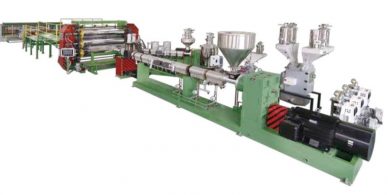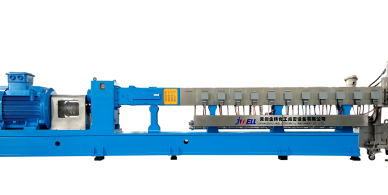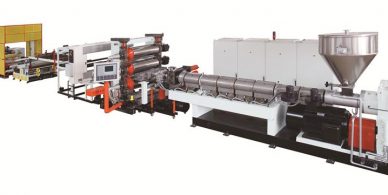
Project
The customer is one of the largest independent manufacturers of refrigerator inner liners and thermoformed appliance components in Central & Eastern Europe. Founded in 1998 and headquartered in the region, the group operates three converting plants across the region, employs around 1,100 people and generates annual turnover of approximately EUR 200 million.
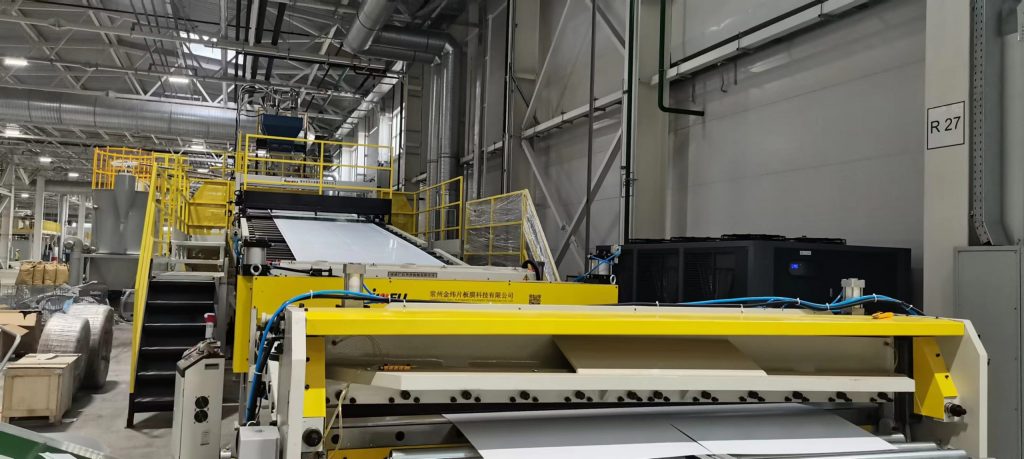
Outsourced sheet supply could no longer keep pace with growing demand for refrigerator and freezer liners across three plants. The new line had to deliver a stable 1000 kg/h at 2400 mm width — about 8,000 t per year at 8,000 operating hours — with consistent thickness uniformity and surface quality over multi-week runs, placing strict demands on screw design, melt temperature control and downstream take-off stability.
Supplying several OEMs simultaneously, the customer runs varied HIPS and ABS grades — including food-contact, high-impact and flame-retardant grades — in multiple colours. The line had to support HIPS-to-ABS changeover within a single shift, including screw purge, die cleaning and one-touch recall of process recipes, to keep changeover losses below 2 % of available production time.
At 2400 mm, wide-web extrusion demands even melt distribution across the full die face. ABS’s relatively poor flowability makes 2400 mm extrusion prone to centre-thick / edge-thin deviation and melt-temperature spread, requiring simulation-optimised manifold geometry, a restrictor bar and flexible lip adjustment on the T-die — with melt temperature spread held within ±3 °C.
As an EU installation, the line had to be delivered with CE marking under Machinery Regulation (EU) 2023/1230, electrical design to EN 60204-1, guarding per EN ISO 12100, plus REACH / RoHS conformity and EU 10/2011 food-contact compliance for liner grades. With electricity prices in the region among the highest in the EU, the customer also set a specific energy consumption target of ≤ 0.36 kWh/kg and required per-kg energy monitoring.
Entering extrusion for the first time, the customer had no in-house high-end extrusion maintenance capability. It required proven European installation and commissioning resources, a locally stocked spare-parts supply, multilingual (English plus local-language) engineering support and 7×24 technical response with 48-hour on-site attendance to guarantee minimal unplanned downtime after start-up.
Vacuum thermoforming of deep-draw refrigerator and freezer liners is extremely sensitive to thickness tolerance, surface gloss and residual stress of the plate. Any minor defect is amplified during thermoforming — uneven liner walls, whitening at draw corners or low-temperature cracking at −30 °C — leaving virtually zero tolerance for quality deviation in extrusion.
| Screw diameter | 150 mm |
| L/D ratio | 38:1, with vacuum degassing for volatiles and moisture |
| Barrel | Bimetallic lined, nitrided, wear & corrosion resistant, suited for flame-retardant ABS compounds |
| Screw type | Barrier screw with dedicated mixing section, optimised for HIPS / ABS rheology |
| Drive | 400 kW AC vector inverter drive, 0.01 rpm resolution, output fluctuation ≤ 1 % |
| Heating | Ceramic heater bands, PID multi-zone control, accuracy ±1 °C |
| Output | Up to 1200 kg/h (HIPS); duty point 1000 kg/h HIPS / approx. 880 kg/h ABS at 2400 mm |
| Energy | IE4 high-efficiency motor, 0.32–0.36 kWh/kg with per-kg consumption reporting |
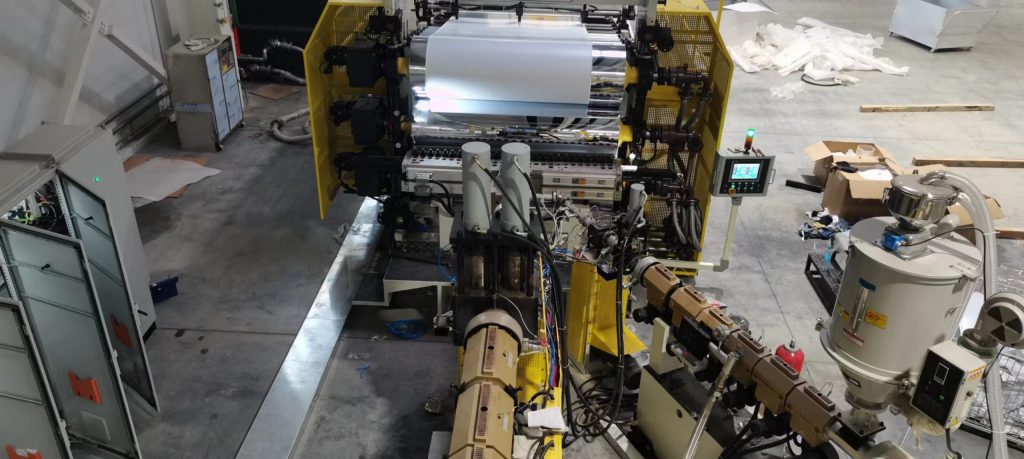
The JWS150 barrier screw is specially tuned for HIPS/ABS rheology, resolving common issues of melt temperature non-uniformity and surface flow marks in wide-width extrusion. The 38:1 L/D ensures full melting and efficient degassing for a cleaner, higher-gloss plate surface — a prerequisite for defect-free deep-draw thermoforming.
The line supports A/B/A three-layer co-extrusion: high-gloss virgin ABS or HIPS cap layers on both surfaces (guaranteeing surface quality and thermoforming performance), while the core layer can incorporate regrind, off-spec trim and lower-cost compound — reducing raw material cost by approx. 25–30 % without compromising performance. Each layer is fed by an independent melt gear pump for precise layer-ratio control (±2 %), with the co-extruder rated up to 300 kg/h.
| No. | Application | Notes |
|---|---|---|
| 1 | Refrigerator & freezer inner liners | Vacuum-thermoformed deep-draw liners; high impact strength at −30 °C, food-grade compliance (EU 10/2011), excellent thermoformability |
| 2 | Refrigerator door liners | Laminated or co-extruded high-gloss cap layer; matches door shell stamping and foaming process |
| 3 | Appliance housing panels | Washing machine tops, AC panels, microwave housings; uniform gloss and dimensional stability |
| 4 | Advertising signage & display | Screen-printing substrate, lightbox panels, POS displays; flatness and printability |
| 5 | Automotive interior parts | Door panel substrates, trunk and dashboard liners; meets automotive VOC emission requirements |
| 6 | Luggage & sanitary ware | Suitcase shells and liners, shower tray and bathtub thermoforming plate; impact and chemical resistance |
Central & Eastern Europe hosts regional plants of Whirlpool, Samsung, Beko Europe, LG and Amica and is among the EU’s largest production bases for household refrigeration appliances. A leading liner converter — with 25 years of thermoforming know-how — moving upstream into ABS/HIPS plate extrusion reflects the wider European trend of component makers internalising raw-material supply to protect margin and shorten lead times. JWELL’s selection by such a demanding, audit-driven customer reinforces its brand credibility in the European white-goods equipment market.
The line was awarded against established European extrusion OEMs. JWELL won on a combination of CE-compliant engineering, roughly 30 % lower capital investment, significantly shorter delivery lead time and a committed European service presence — evidence that Chinese high-end extrusion equipment is now accepted in a mature, regulation-heavy market where uptime and compliance matter more than headline price.
Positioned between the JWS130 + JWS65 package at 850 kg/h and the JWS150 + JWS90 high-capacity package at 1200 kg/h (both already in serial production), this line establishes the 1000 kg/h / 2400 mm configuration as the optimum solution for large-cabinet refrigerator platforms and 2.4 m-wide thermoforming tools — the fastest-growing segment in European liner converting.
Building on earlier sheet and board lines delivered in the region, this project anchors JWELL’s European service model: an EU spare-parts warehouse for fast-moving items, resident field engineers, multilingual 7×24 hotline and 48-hour on-site response, plus a training programme that builds the customer’s own extrusion maintenance capability. It converts a single machine sale into a long-term partnership covering maintenance, spare parts and process upgrades.
Draft for internal review — customer-identifying details (company name, plant locations, headcount, turnover, programme name) are illustrative placeholders to be replaced with verified data before external release.
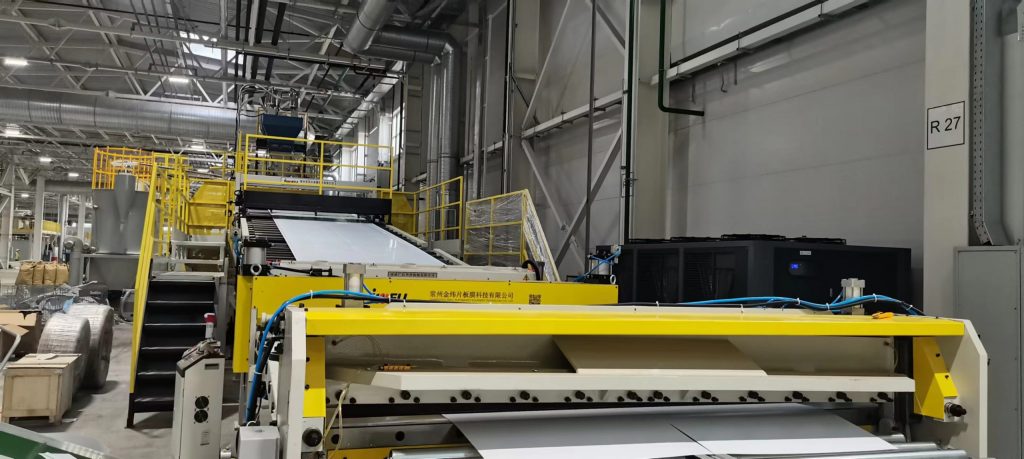
Download our document to see specific data of the service and how we work.