Solution
PC Hollow Cross plate widely used in Construction of sunroof in building, halls, shopping center, stadium ,public places of entertainment and public facility.
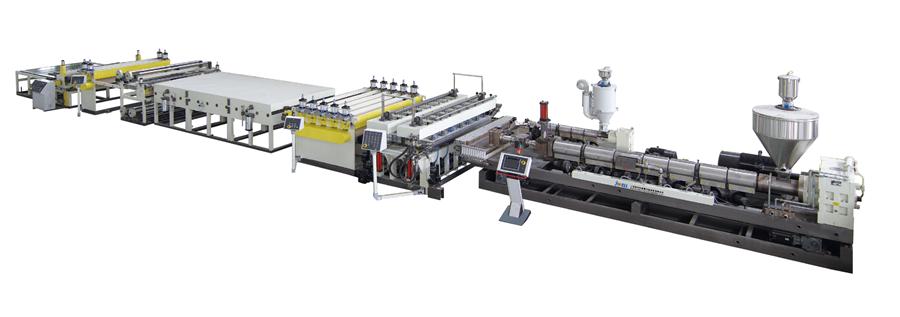
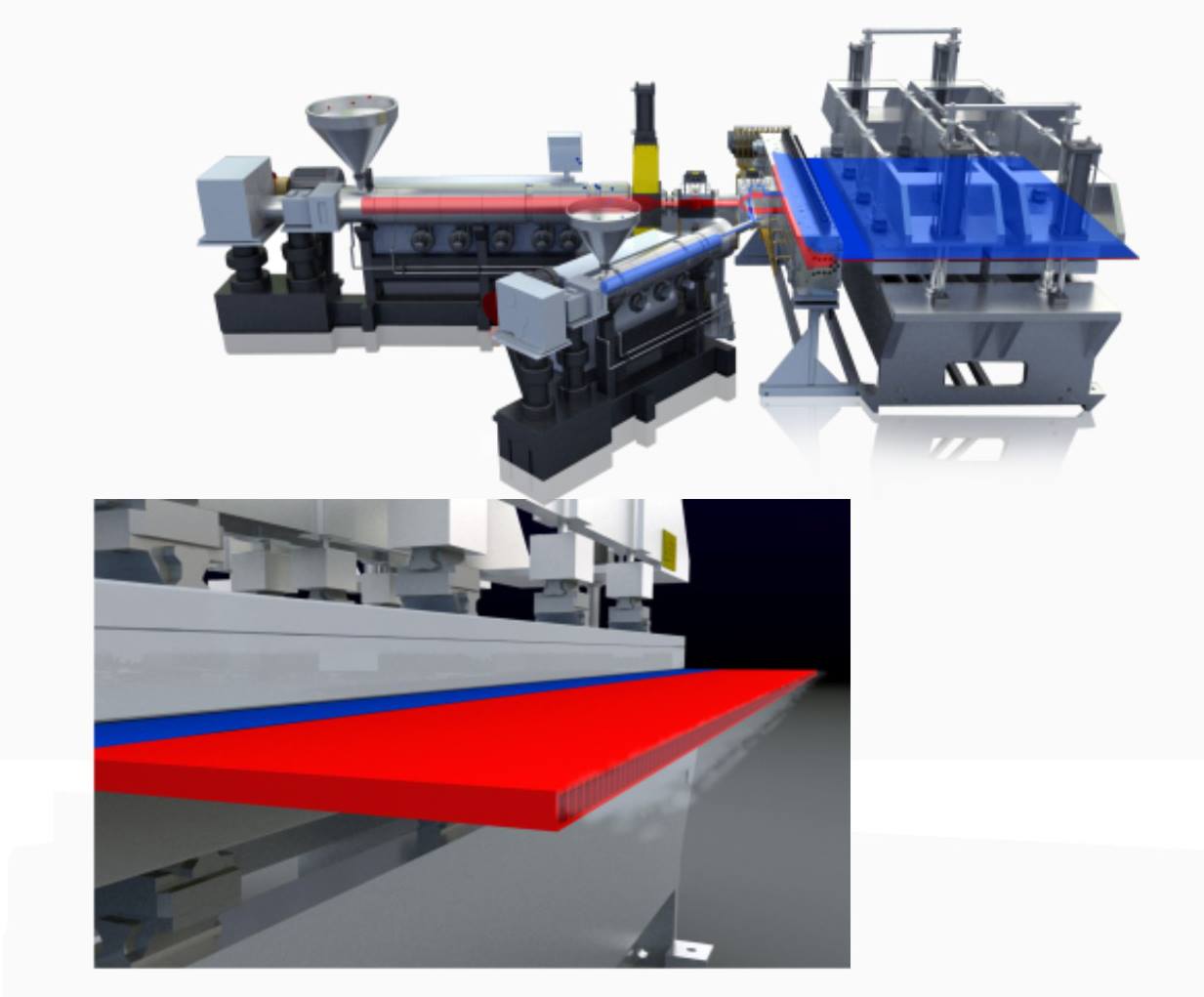
| Model | JW120/38+JW45/30 | JW120/38 |
| Product Width (mm) | 2100 | 1300 |
| Sheet Thickness (mm) | 2~10 | 2~10 |
| Machine Capacity (kg/h) | 450 | 300 |
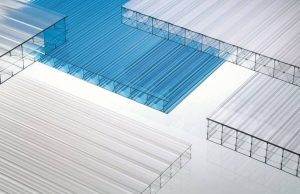

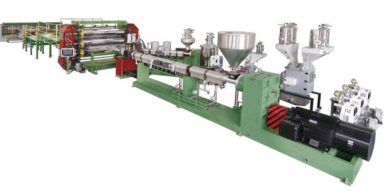
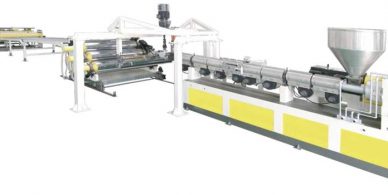
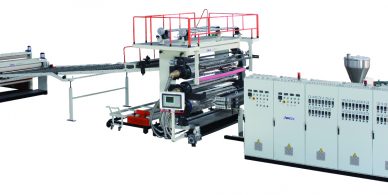
A PC hollow sheet extrusion line is a complete production system that manufactures polycarbonate hollow sheets, also known as PC sunshine boards or polycarbonate hollow boards, from transparent PC granular raw material. The line typically consists of a single-screw main extruder, a co-extruder for UV protection layer application, a hydraulic screen changer, a precision die, a vacuum calibration and forming table, tractors, an annealing oven, and cutting equipment. JWELL’s PC hollow sheet extrusion lines produce sheets with widths from 1,220 mm to 2,100 mm and thicknesses from 2 mm to 40 mm, with production capacities of 300–450 kg/h depending on the model.
PC hollow sheet (also called PC sunshine board) features an internal honeycomb or rectangular hollow structure with two or more parallel walls connected by ribs, providing superior thermal insulation and lightweight characteristics. PC solid sheet is a flat, solid panel without internal voids, offering higher impact strength and optical clarity. Hollow sheets are primarily used for architectural glazing, greenhouse roofing, and canopy applications where weight reduction and heat insulation are priorities. Solid sheets are preferred for applications requiring maximum transparency and impact resistance, such as safety glazing and riot shields. JWELL’s extrusion lines are specifically designed for PC hollow sheet production with vacuum forming technology.
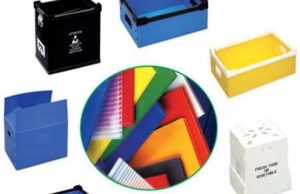
PC hollow sheets serve a wide range of applications across multiple industries: building and construction (sunroofs for shopping centers, stadiums, halls, and public facilities; canopy systems for bus terminals, garages, and corridors; sound barriers and swimming pool covers), safety and security (transparent shields at airports, factories, and nursery schools), and secondary processing products (turnover boxes, packing boxes, partition dividers, liners, pads, and bottom brackets). The sheets are also used in electronics, home appliances, luggage, food packaging, medicine, advertising, and decoration industries.
JWELL offers PC hollow sheet extrusion lines with two production capacity tiers. The JW100/38+JW45/30 model produces sheets up to 1,300 mm wide at 300 kg/h, with a main motor power of 132 kW. The JW120/38+JW45/30 model produces sheets up to 2,100 mm wide at 450 kg/h, with a main motor power of 185 kW. Both models feature a 120 mm diameter main screw with a 38:1 L/D ratio, paired with a 45 mm diameter co-extruder with a 30:1 L/D ratio for UV layer application. The production capacity varies based on sheet thickness, wall structure complexity, and number of ribs.
Polycarbonate material is inherently susceptible to UV degradation when exposed to sunlight, which causes yellowing, loss of transparency, and reduced mechanical strength over time. The UV co-extruder applies a thin UV-resistant layer on the outer surface of the PC hollow sheet during the extrusion process, protecting the base material from solar radiation. JWELL’s PC hollow sheet lines integrate a 45 mm co-extruder (model JW45/30) with the main extruder, enabling single-pass UV layer application. This eliminates the need for secondary coating processes, reduces production cost, and ensures consistent UV protection across the entire sheet surface.
The vacuum forming table (vacuum calibration unit) is a critical component that shapes and cools the molten PC sheet extruded from the die. JWELL’s vacuum forming table features a fast heat exchange refrigeration system, a staggered multi-zone vacuum system with even suction distribution, and multiple three-point fixed-cycle vacuum groups. Each group includes an independent vacuum adjustment and display system, ensuring uniform and stable vacuum across the sheet surface. This precise vacuum control is essential for forming the internal hollow structure (ribs and walls) of the PC sheet accurately and maintaining consistent wall thickness throughout production.
Annealing is a heat treatment process applied after the PC hollow sheet is formed and before it is cut to final length. The sheet passes through an annealing oven that uses advanced large-area conduction heating to relieve internal stresses generated during the extrusion and cooling process. Without proper stress elimination, PC hollow sheets may develop warping, cracking, or dimensional instability over time. JWELL’s production line integrates a stress eliminator unit that ensures flatness and dimensional accuracy of the finished PC sheets, which is particularly important for architectural applications where sheets must maintain structural integrity under thermal cycling conditions.
JWELL’s PC hollow sheet extrusion lines produce sheets with thicknesses ranging from 2 mm to 40 mm depending on the model and configuration. The JW100/38 model handles thinner sheets from 2 mm to 10 mm, while the JW120/38 and JWS100+JWS45 models can produce sheets from 4 mm up to 40 mm for heavy-duty applications. Thin sheets (2–6 mm) are typically used for indoor partitions, advertising sign boards, and secondary processing into packaging products. Medium to thick sheets (6–40 mm) are used for structural applications such as building skylights, canopy systems, and sound barriers requiring higher load-bearing capacity and thermal insulation.
PC hollow sheets are available in several internal wall structures to meet different performance requirements. The most common structures include rectangular (straight wall) structure with parallel vertical ribs connecting two flat walls, honeycomb (hexagonal) structure with 360-degree interconnected cells providing uniform stress distribution, three-wall (triple-wall) structure with additional internal walls for enhanced rigidity and insulation, and X-structure or diamond structure with diagonal ribs for superior impact resistance. JWELL’s extrusion lines can be configured with interchangeable dies to produce different wall structures, and the line can also manufacture U-shaped sheets and U-locked sheets for modular installation systems.
Selecting the right JWELL PC hollow sheet extrusion line requires evaluating four factors: (1) Sheet dimensions — match the required width (1,220–2,100 mm) and thickness range (2–40 mm) to your target market demand; (2) Wall structure — determine whether you need rectangular, honeycomb, three-wall, or X-structure dies, as this affects the die design and vacuum forming configuration; (3) UV protection — architectural and outdoor applications require UV co-extrusion capability, which is included as standard with JWELL’s dual-extruder configuration; (4) Production volume — the JW100/38 (300 kg/h) suits medium-scale operations while the JW120/38 (450 kg/h) is designed for high-volume manufacturing. JWELL provides technical consultation, factory acceptance testing, and after-sales support including installation and operator training.