Solution
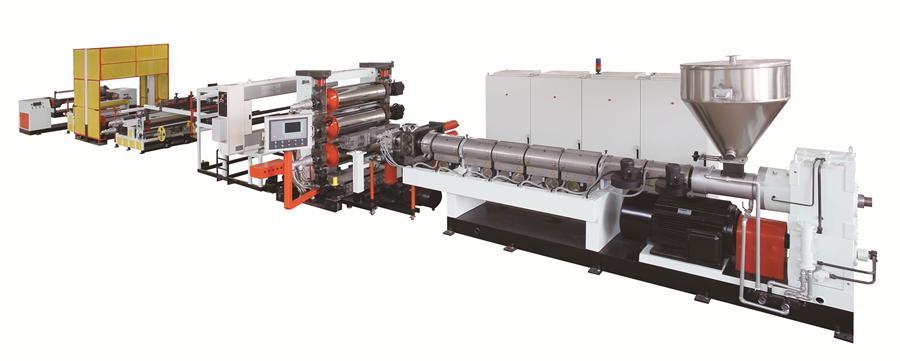
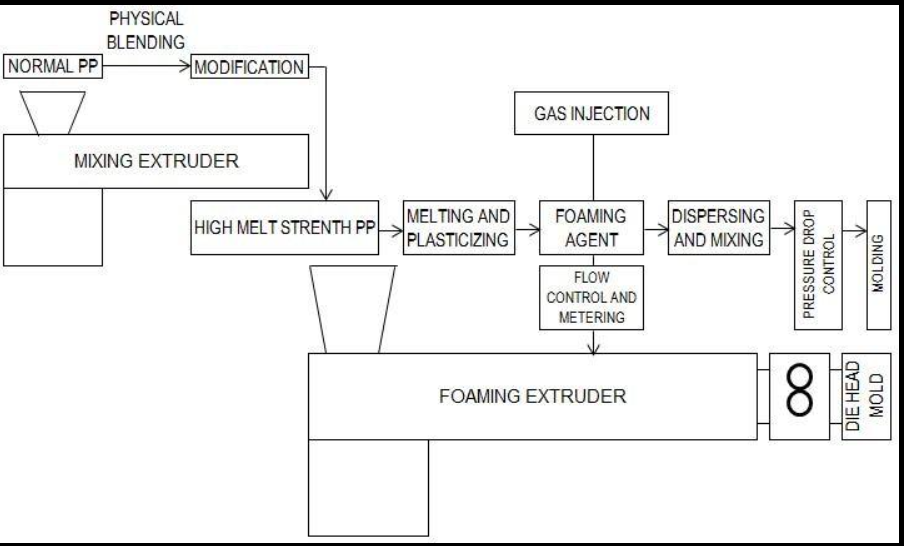
PP foam board production can generally be divided into two main foaming technologies: physical foaming and chemical foaming.
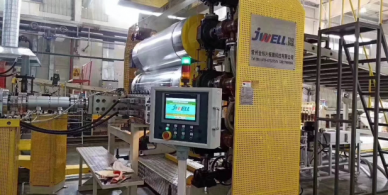
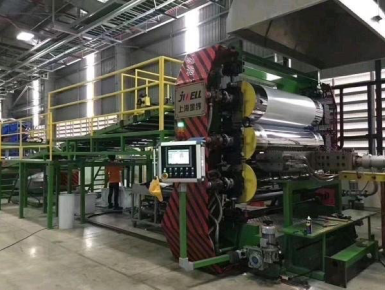
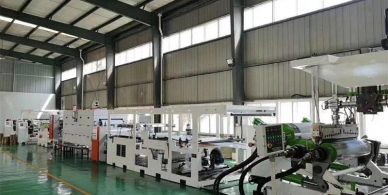
The two processes differ in the way the cellular structure is created and in the configuration of the production equipment. Jwell can provide extrusion solutions according to the customer's target density, board structure, thickness, production capacity and application requirements.
In the physical foaming process, carbon dioxide (CO₂) is used as the physical blowing agent.
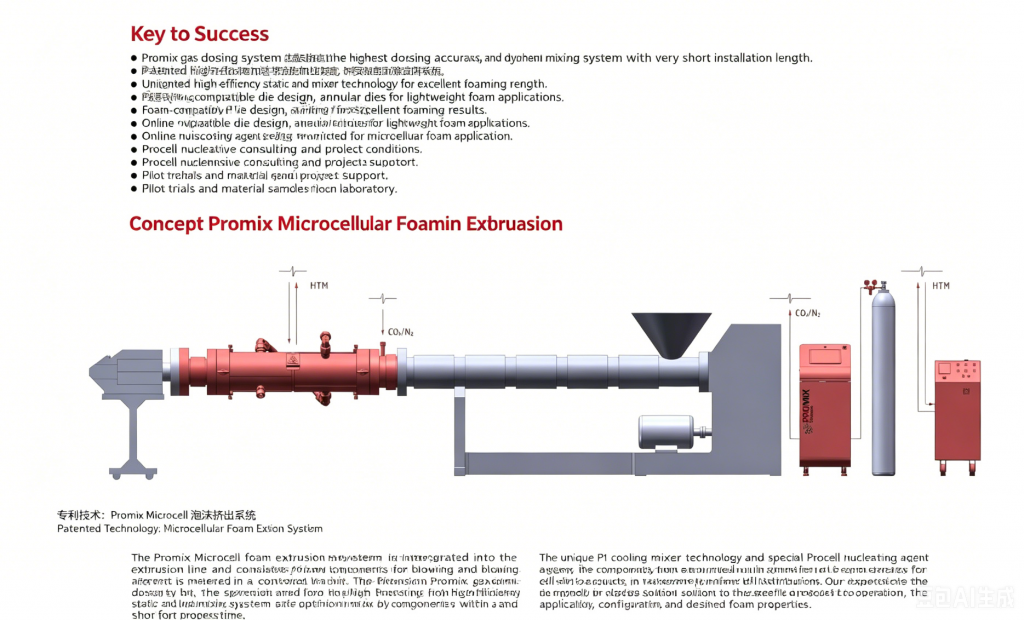
During extrusion, CO₂ is accurately injected into the polymer melt through a dedicated CO₂ injection and metering system. Under controlled temperature and pressure conditions, the CO₂ dissolves into the PP melt. When the pressure decreases through the die and forming process, the dissolved gas expands and creates a fine cellular structure inside the PP sheet.
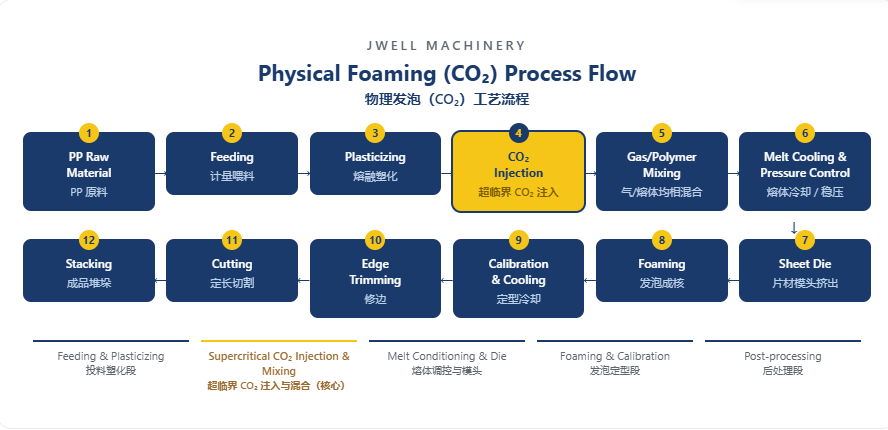
The CO₂ injection system is a key component of this production technology. Precise control of the CO₂ injection rate, melt pressure and melt temperature helps maintain stable foaming conditions.
The actual cell structure and density depend on the PP grade, CO₂ concentration, melt strength, extrusion conditions, die design and cooling/forming process.
The second technology uses a chemical blowing agent incorporated into the PP formulation.
In this process, the extrusion line first produces a microcellular or lightly foamed PP board. The initial extrusion stage does not necessarily produce the final expansion ratio. Instead, the semi-finished board is subsequently subjected to secondary foaming in a dedicated foaming oven.
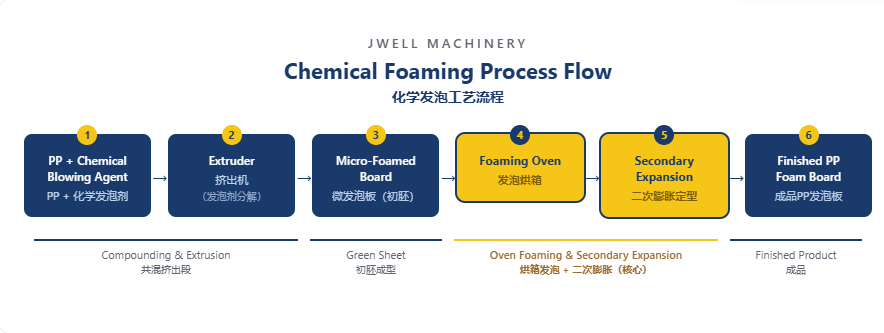
During extrusion, the chemical blowing agent decomposes under controlled processing conditions and generates gas within the polymer matrix, creating a microcellular structure.
The extruded board is then cooled and formed into a stable semi-finished product.
In the second stage, the board is placed in a foaming oven, where controlled heating activates further expansion of the cellular structure. This secondary foaming process increases the board thickness and reduces its final density.
The formulation of the chemical blowing agent and the temperature profile of the secondary foaming oven are important factors affecting the final density, thickness and cell structure.
| Item | Physical Foaming | Chemical Foaming |
|---|---|---|
| Blowing Agent | CO₂ | Chemical blowing agent |
| Gas Introduction | Injected directly into polymer melt | Generated through chemical decomposition |
| Main Equipment | CO₂ injection & metering system | Chemical foaming formulation + foaming oven |
| First Extrusion Stage | Produces foamed board directly | Produces micro-foamed board |
| Secondary Foaming | Normally not required | Required |
| Secondary Equipment | Inline calibration & cooling | Offline foaming oven |
| Expansion | Controlled during extrusion | Mainly developed during secondary heating |
| Process Configuration | Continuous inline process | Extrusion + secondary foaming |
| Density Control | CO₂ dosage + extrusion conditions | Formulation + oven conditions |
| Typical Advantage | Continuous production | Higher secondary expansion potential |
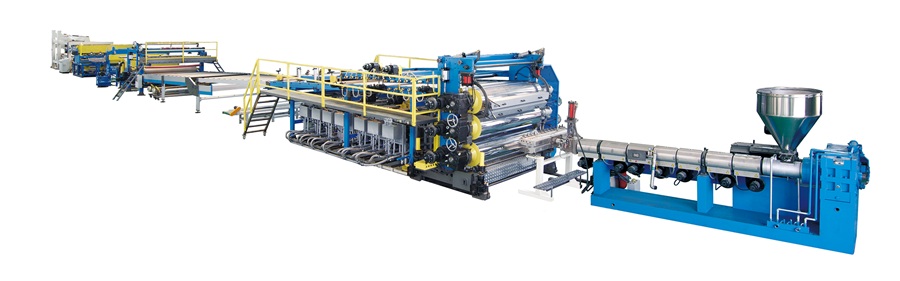
The appropriate foaming technology depends on the customer’s product specifications and production objectives.
The final process should be selected based on the PP grade, formulation, target density, thickness, expansion ratio, cell structure and end-use requirements.
Jwell’s engineering team can evaluate these parameters and recommend the appropriate extrusion and foaming configuration.
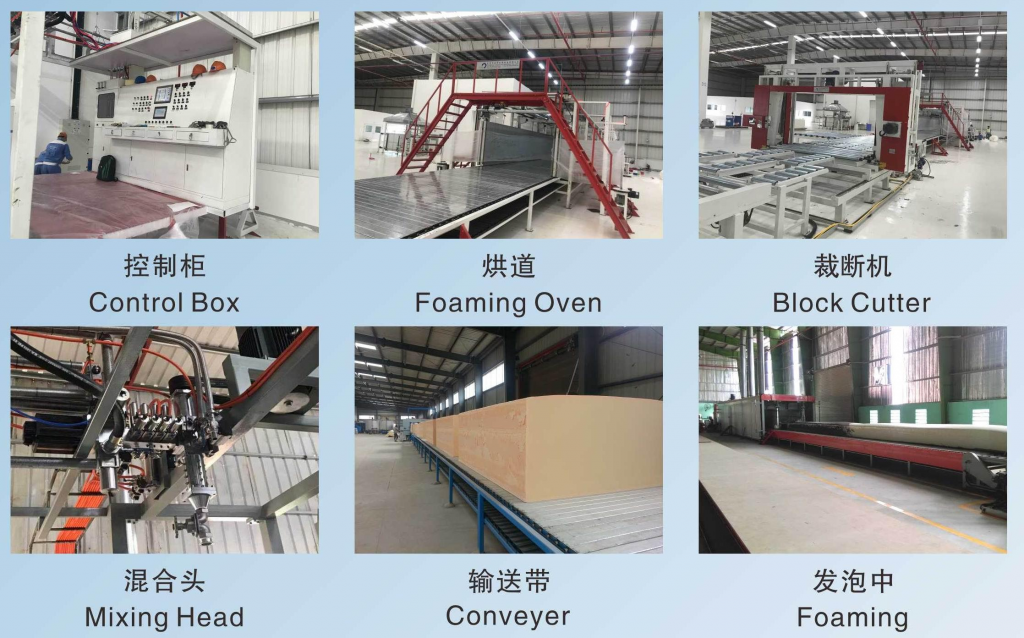
The cellular structure reduces the weight of the board compared with conventional solid PP sheets of similar dimensions. This is particularly useful for large-area boards that need to be manually handled, transported or installed.
Although the board contains a large number of internal cells, an appropriately designed PP foam structure can provide good rigidity and dimensional stability.
PP is inherently resistant to water absorption. This makes PP foam board suitable for humid environments and applications where conventional fiber-based boards may have limitations.
Polypropylene provides good resistance to many common chemicals, making PP foam board suitable for industrial and construction-related applications.
The combination of PP’s toughness and the cellular structure can provide good resistance to impact and mechanical handling.
PP foam board is based on polypropylene, a thermoplastic material that can be recycled and reprocessed when the material composition and application allow it.
PP foam boards can be cut, drilled, printed, laminated and fabricated according to the requirements of the final application.
The extrusion system is designed to provide stable melting and homogenization of PP material before the foaming stage.
Stable melt temperature and pressure are important for achieving consistent cell formation and board thickness.
Foaming technology is one of the most important parts of PP foam board production.
The extrusion system can be configured according to the selected foaming method and target product density.
It can be adjusted to control the cellular structure of the finished board.
A consistent cellular structure helps improve the balance between:
The extrusion and forming system is designed to maintain stable processing conditions across the production width.
The die plays a critical role in determining the width and thickness uniformity of the PP foam board.
Jwell can configure the sheet die according to the required.
For wider boards, precise melt distribution becomes particularly important to reduce thickness variation across the sheet.
After extrusion and foaming, the board needs to be properly shaped and cooled.
The downstream calibration and cooling system helps control:
This is especially important for construction boards that will subsequently be cut, laminated, printed or fabricated.
The downstream system can be configured for automatic cutting and stacking of finished PP foam boards.
Depending on the project requirements, the line can be designed for continuous production with automatic length control and board handling.
This reduces manual handling and improves overall production efficiency.
Different PP foam board applications require different product specifications.
Jwell can customize the extrusion line according to the customer’s requirements for:
Width | Thickness | Density | Output | Surface | Application
This allows the same production platform to be optimized for different board specifications and markets.
| Model | JW120-1600 | JW150-2100 | JW180-2600 | SJZ80/156-1500 |
| Material | PP | PP | PP | PVC |
| Products Width(mm) | 1220 | 1500 | 2000 | 1220 |
| Sheet thickness (mm) | 3~30 | 3~30 | 3~30 | 3~30 |
| Capacity( kg/h) | 350 | 500 | 800 | 400~500 |
PP foam materials are particularly suitable for applications that require a combination of low density, impact resistance, resilience, thermal insulation and low dielectric properties.
These characteristics make PP foam materials suitable for applications where weight reduction, mechanical protection, thermal performance and dimensional stability are important.
Typical applications include new energy battery protection panels, 5G antenna covers, energy storage battery protection panels, refrigerated MPP vehicle body panels and model aircraft.

PP foam board can be used as a lightweight protective material for new energy vehicle battery systems.
The battery pack is exposed to potential mechanical impact, road debris, vibration and environmental conditions during vehicle operation. A lightweight cellular PP structure can provide a combination of impact resistance, toughness and weight reduction, making it attractive for battery protection components.
Compared with a solid polymer board of the same dimensions, a foamed PP structure can reduce material density and therefore help reduce the overall weight of the protective component.
For EV applications, the final board formulation and structure should be selected according to the required mechanical performance, temperature range, flame-retardancy requirements and vehicle design.
Typical application: EV battery underbody protection and lightweight battery protection panels.

PP foam materials can be considered for protective structures used around 5G communication equipment where low dielectric properties, low density and environmental resistance are important.
5G antennas and related RF components require protective covers, often referred to as radomes, that protect sensitive components from rain, dust, mechanical impact and outdoor exposure while minimizing interference with electromagnetic signals.
The low dielectric characteristics of polypropylene make PP-based materials attractive for RF-related applications. A controlled foam structure can further reduce material density and dielectric loading.
The dielectric constant and RF performance of the final component depend on the PP grade, density, cell structure, additives, frequency and component design. Therefore, material selection should be verified through application-specific testing.
Typical application: 5G antenna protective covers, radome structures and communication equipment housings.


Large-scale energy storage systems require protective structures to shield battery modules and associated components from mechanical damage and environmental exposure.
PP foam board can provide a lightweight alternative for selected protective panels, covers and structural components where low weight, impact resistance and moisture resistance are required.
The cellular structure can reduce the weight of large-area panels while maintaining useful rigidity and toughness.
For energy storage applications, the material specification must be matched to the system’s safety requirements. Where flame retardancy, electrical insulation or specific temperature performance is required, the PP formulation and board structure should be engineered accordingly.
Typical application: energy storage battery protection panels, covers and enclosure components.


MPP (microcellular polypropylene) is particularly suitable for lightweight panel applications in refrigerated transportation.
Refrigerated trucks and vans require panel structures that combine low weight, rigidity, moisture resistance and thermal insulation performance.
The microcellular PP structure can reduce the density of the panel while providing useful insulation properties. PP’s resistance to moisture is also beneficial in refrigerated environments where condensation and temperature changes may occur.
MPP panels can be designed as part of a multilayer vehicle body structure, depending on the required thermal insulation and mechanical performance.
Typical application: refrigerated truck body panels, refrigerated van panels and lightweight insulated vehicle structures.


The combination of low density, toughness and resilience makes PP foam materials suitable for model aircraft and other lightweight model structures.
For model aircraft, reducing structural weight can improve flight performance and energy efficiency. At the same time, the material needs sufficient toughness to withstand repeated handling and landing impacts.
PP foam board can be cut and formed into components such as:
The density and cell structure can be adjusted according to the balance required between weight and rigidity.
Typical application: RC model aircraft, educational model aircraft and lightweight model structures.
The above applications share several common material requirements.
The cellular structure reduces material density, making PP foam attractive for applications where component weight directly affects transportation, handling or vehicle efficiency.
Polypropylene has good toughness, while an appropriately designed cellular structure can provide additional energy absorption characteristics.
PP’s inherent flexibility and recovery characteristics make it suitable for applications exposed to repeated mechanical loading or impact.
The cellular structure can reduce heat transfer compared with solid PP, making PP foam useful in selected insulation and refrigerated transportation applications.
Low-density PP foam can be attractive for RF and communication-related components where dielectric performance is an important consideration.
Polypropylene has very low water absorption compared with many conventional board materials, making PP foam suitable for humid and condensation-prone environments.
| Application | Main Requirements | PP Foam Advantage |
|---|---|---|
| New Energy Battery Protection Panel | Impact resistance, lightweight, toughness | Lightweight + impact protection |
| 5G Antenna Protective Cover | Low dielectric properties, low weight, weather resistance | Low density + low dielectric characteristics |
| Energy Storage Battery Protection Panel | Lightweight, impact resistance, moisture resistance | Lightweight + durable |
| Refrigerated MPP Vehicle Body Panel | Thermal insulation, low weight, moisture resistance | Cellular structure + moisture resistance |
| Model Aircraft | Very low weight, resilience, toughness | Lightweight + resilient structure |
The performance of PP foam products depends on more than simply reducing material density.
For each application, the PP grade, foaming method, density, cell size, cell distribution, board thickness and downstream forming process need to be considered together.
For example:
Therefore, the PP foam board extrusion process should be designed around the final application and required material performance, rather than using the same foam structure for every product.
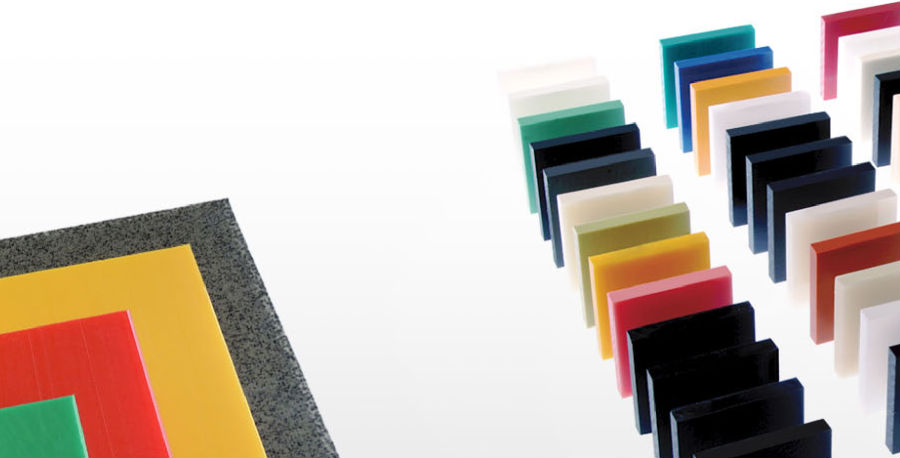
PP foam board is a lightweight polypropylene sheet containing a cellular structure created through a controlled foaming process. It combines the basic properties of PP with reduced density and lower weight.
The main difference is the internal structure. Solid PP sheet has a dense polymer structure, while PP foam board contains controlled gas cells. As a result, PP foam board can achieve lower weight and improved material efficiency.
PP itself has good moisture resistance, but outdoor durability depends on formulation, UV stabilization, thickness, density and the specific application. For long-term outdoor use, the material formulation should be designed accordingly.
PP is a recyclable thermoplastic. However, recyclability depends on the actual material composition, additives, coatings, laminations and local recycling infrastructure.
Density is influenced by the PP material, foaming agent system, processing conditions, extrusion configuration and target cell structure.
Yes. The extrusion line can be configured according to the required board width, thickness, density, output, surface structure and application.
For an accurate proposal, customers should provide the target material, board width, thickness, density, required output, application and preferred production method. Based on these parameters, Jwell engineers can recommend a suitable line configuration.
Jwell has extensive experience in polymer extrusion equipment and sheet and plate production technologies.
For PP foam board projects, the value of an extrusion equipment supplier is not simply the extruder itself. Stable production requires the correct combination of extrusion, foaming, die, forming, cooling and downstream handling technology.
Jwell’s engineering team can work with customers to develop a complete production solution based on their product requirements, raw materials and target production capacity.
From material testing and process development to equipment manufacturing, commissioning and technical support, Jwell provides an integrated approach to PP foam board extrusion.
Are you planning to manufacture PP foam board, PP foamed sheet or lightweight PP construction panels?
Send us your target:
Material + Width + Thickness + Density + Output + Application
Our engineers can recommend a suitable PP Foam Board Extrusion Line configuration based on your product requirements.
Contact Jwell for a customized PP foam board extrusion solution.
PP foam board production requires coordination between material formulation, extrusion, foaming, die design and downstream forming.
As an extrusion equipment manufacturer, Jwell can provide engineering support covering the complete production process, including:
The final equipment configuration is developed according to the customer’s target product rather than using a single standard machine configuration for every project.